 Brain Train
Lattice: rebuild the pattern after it disappears
Rebuild the pattern after it disappears.
A handful of cells in a grid light up for a moment, then the grid goes blank. You tap the same cells back from memory. No trick, no rule to learn — just a picture you have to hold onto after it's gone.
▶ Play Lattice on Google Play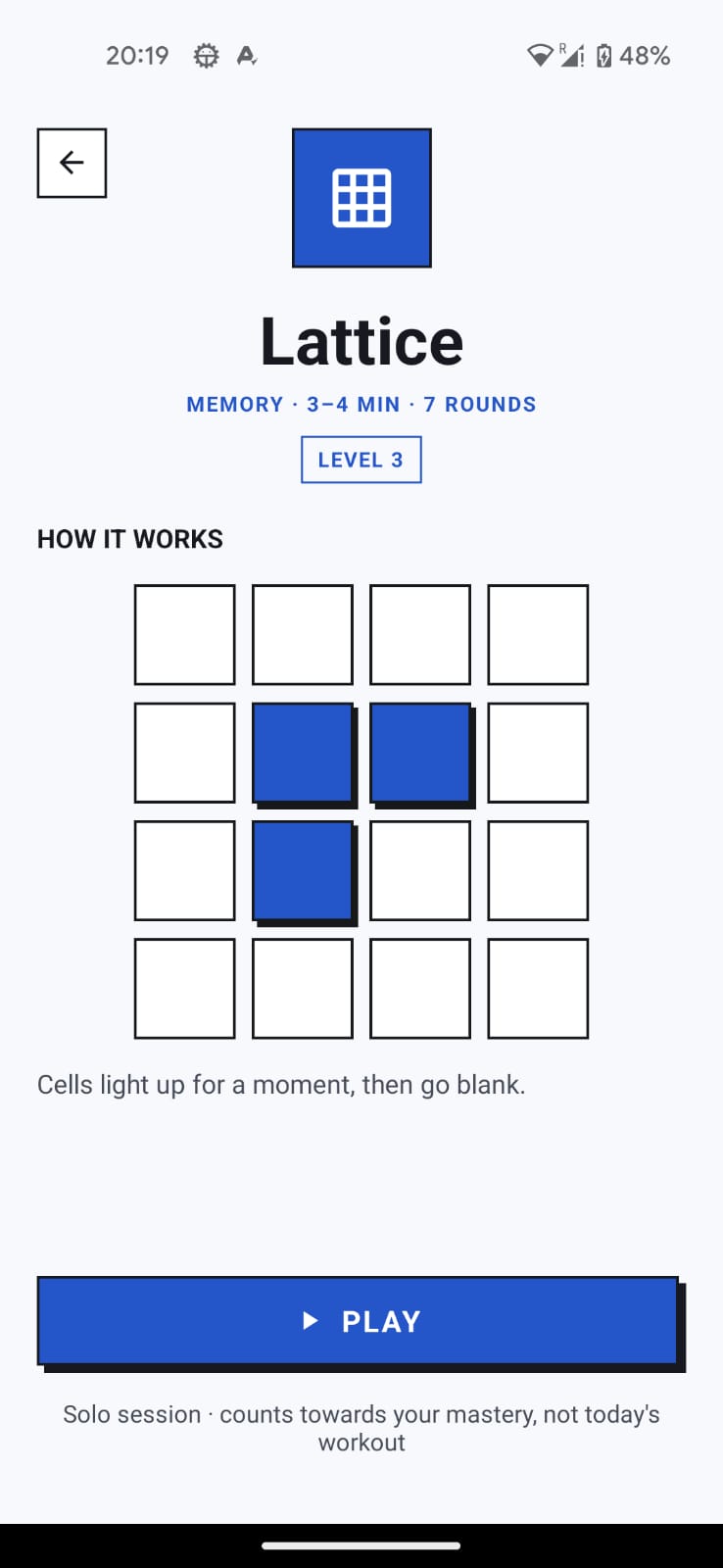
What visual memory actually means here
Remembering a list of words and remembering a picture use overlapping but distinct machinery — holding a spatial layout in mind, rather than a sequence of items, is its own skill: visuospatial working memory. It's what you use to recall where something was on a page, or where a piece was on a board, after looking away.
How Lattice trains it
A set of cells lights up briefly across the grid, then everything goes dark. You tap the cells that were lit — all of them, in any order. Get one wrong or miss one and the round ends. As you improve, more cells light up and the moment you get to look at them gets shorter.
Why it's not like your other brain training
Echo, Lattice's closest neighbor in the memory category, never lets the picture settle — its target keeps moving and the memory keeps getting overwritten. Lattice is the opposite: one snapshot, gone, and you rebuild it. That's the more familiar shape of "remembering something" — a static scene held after it disappears, not a stream that keeps updating.
Questions about Lattice
What is visuospatial memory?
It's the kind of memory that holds a spatial layout — where things are, not just what they are. It's a distinct skill from remembering a list of words or numbers, and it's what Lattice is built to test.
Why does the number of lit cells matter?
More cells means more to hold in mind at once, and a shorter look means less time to encode it. Both make the same task harder without changing what it's actually testing.